The Igloo object did not originate from a concept or a predetermined staging idea. It was not the result of a plan; it emerged from an experience of crisis—a profound creative impasse, both personal and collective.
It grew out of a tension that had been building in silence for a long time, fuelled by frustration, a sense of unfulfilment and suspension. Paradoxically, it was precisely this moment of crisis that became a turning point.
Another important catalyst was the long-term creative process: years of work on the project, hundreds of hours spent in rehearsals and meetings, analysing the text and searching for an appropriate form. This accumulation of intellectual, physical and emotional experience created the foundation that enabled a spontaneous impulse to develop into a meaningful creative act.
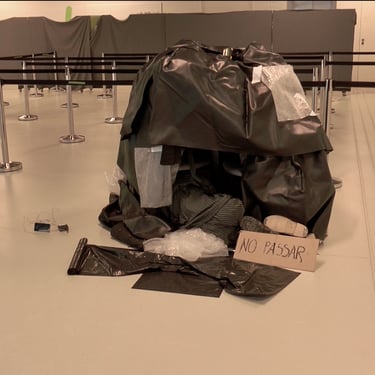
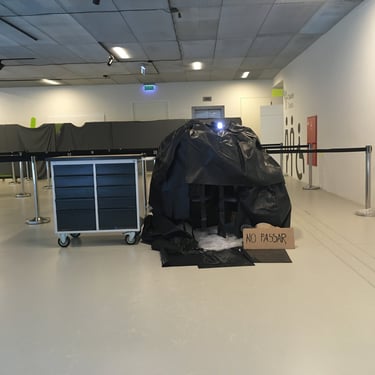
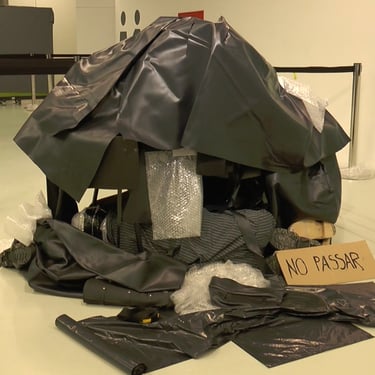
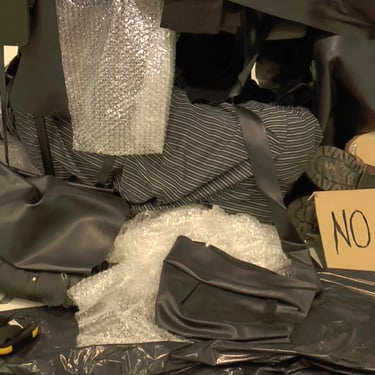
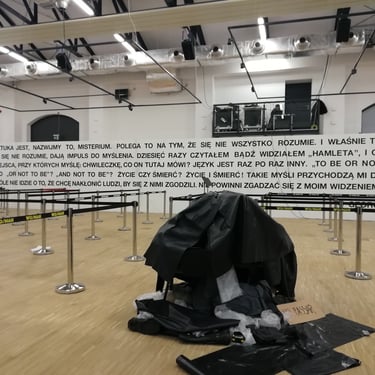
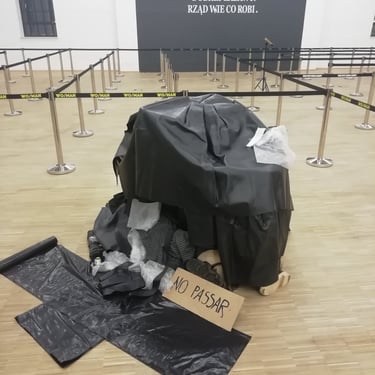
Igloo is an object with an irregular, enclosed structure. Its framework consisted of three chairs arranged in such a way as to create a recess—an internal micro-space. The construction was covered with heavy black rubber costumes, whose matte, dense texture gave it a massive, bodily quality reminiscent of skin. The outer shell was supplemented with layers of black refuse bags, sheets of bubble wrap and fabrics with a pronounced weave. The bubble wrap added further texture to the surface and reinforced associations with insulation and protection from the surrounding environment.
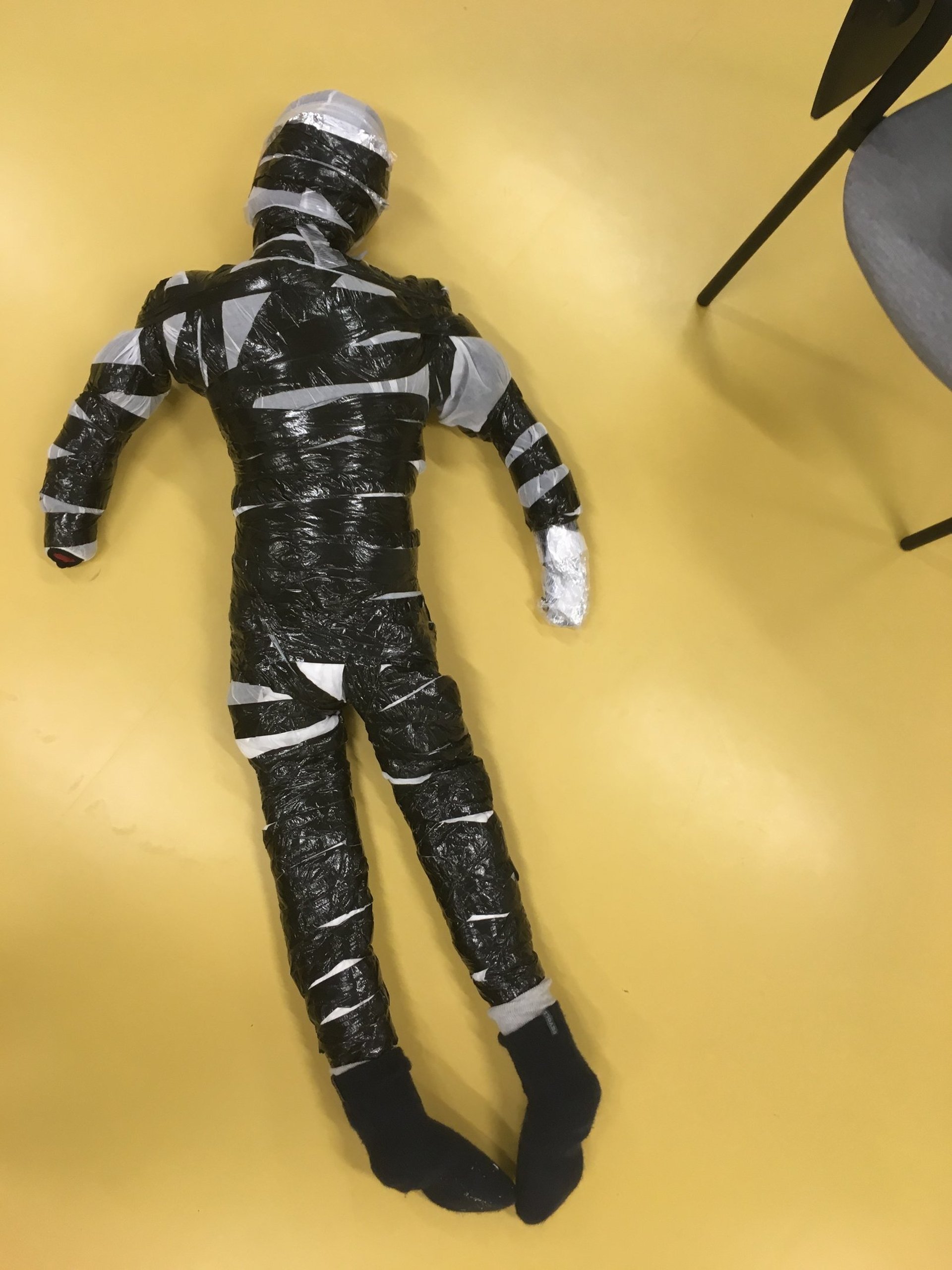
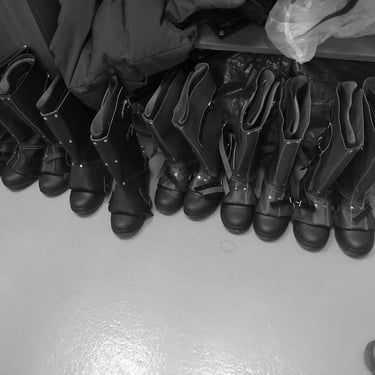
Black plastic sheeting was spread around the object, marking out a visual “border zone”. Within this space, pairs of worn shoes were placed—partially unlaced, abandoned or leaning against the structure—evoking associations with deserted places, temporary shelters and traces of human presence. The interior of the Igloo was occupied by a mannequin dressed in pyjamas and positioned in a foetal pose, its limbs partially covered with materials, as though it were shielding itself from the gaze of the outside world. In front of the entrance stood a cardboard sign bearing the words “NO PASSAR”, functioning both as a warning and as a performative commentary on boundaries, exclusion and prohibition.
The dominant black of the materials, broken by reflections from the plastic and the flesh-like texture of the rubber, gave the object a raw, industrial character. Its irregular, partially collapsed shape reinforced the impression of impermanence. The structure took the form of a hemisphere, although its surface was asymmetrical and lacked a clearly defined outline. Visually, the Igloo resembled a makeshift shelter—a “homeless person’s home”—constructed from random, readily available materials.
In professional theatre, one often hears the phrase: “No rehearsal is ever wasted.” Although it may sound commonplace, in this instance it acquired its full meaning. Every moment—even one that appears unproductive—can give rise to something new.
In the case of the Igloo, the result was an autonomous art object, created unexpectedly out of the need to act in the here and now: an almost biological impulse, yet one deeply rooted in experience and the actors’ training.







Contacts
Krzysztof Ogłoza
phone; +48 608519443
e-mail: krzysztof.ogloza@gmail.com