











Installation Description
Libera’s art installation was designed and adapted for the former miners’ bathhouse at the Silesian Museum in Katowice. The project involved arranging two separate spaces that together formed an integral whole. The first—a small room—served as a kind of introduction through which visitors had to pass before reaching the second, main hall: an impressively large space in which the central artistic event took place. A specially constructed corridor was also incorporated into the hall. It created the illusion of an entrance to the main exhibition space, but in fact led participants back towards the exit.
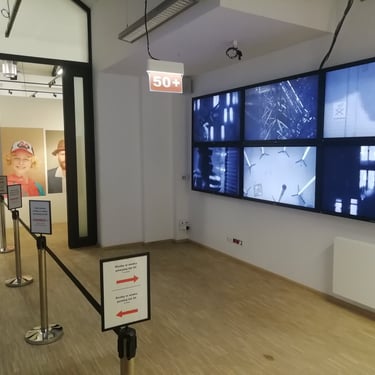
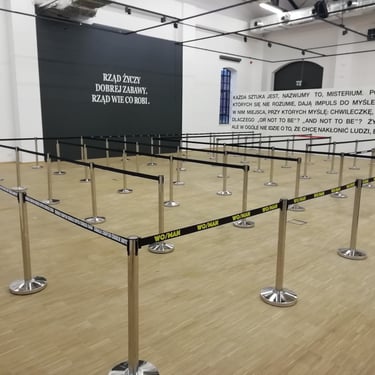
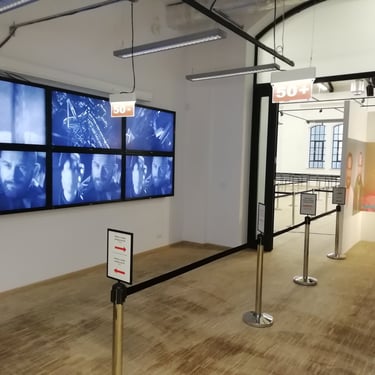
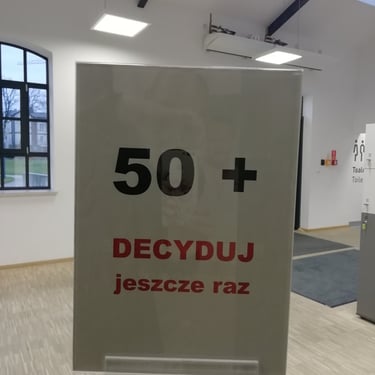
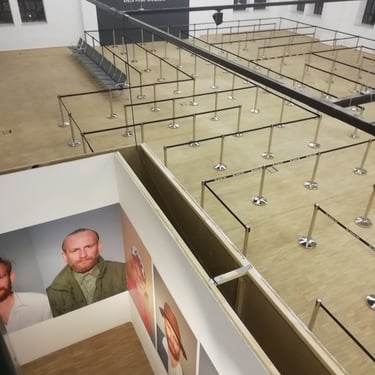
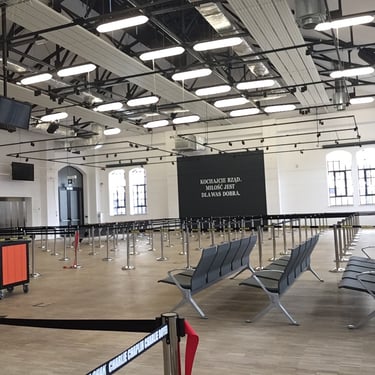
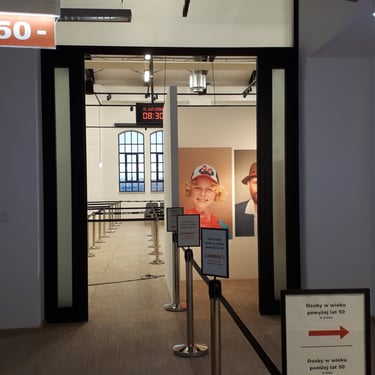
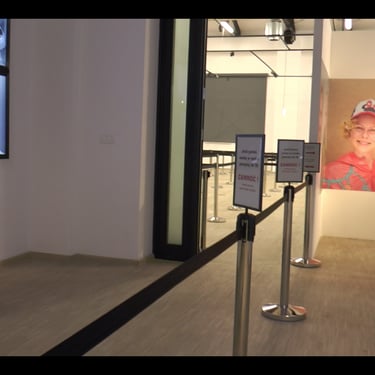
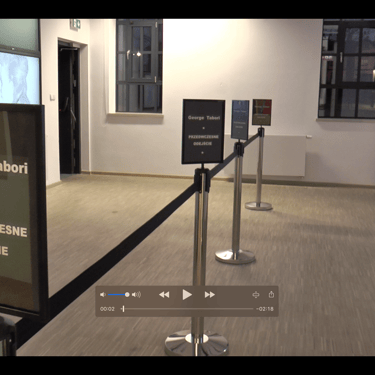
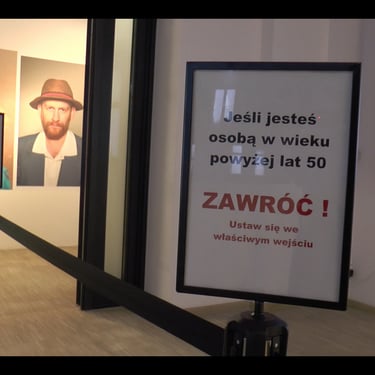
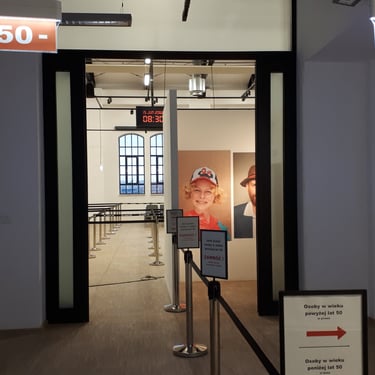
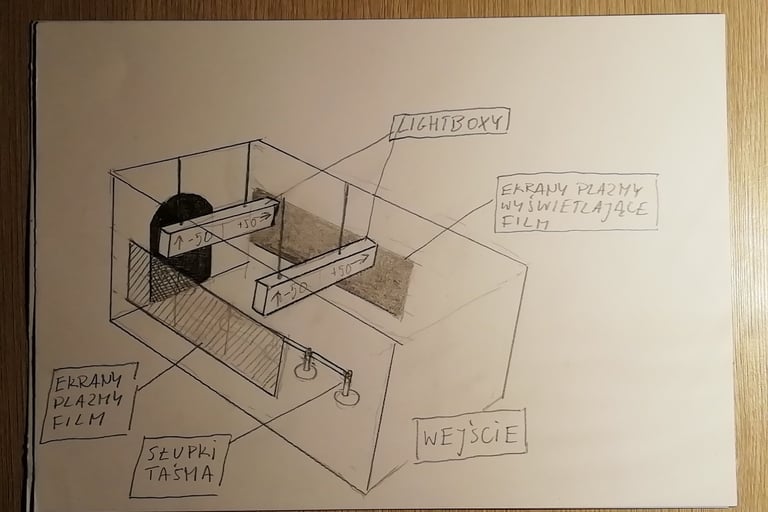
The audience entered through the so-called Conference Room—a narrow space ending in a set of large doors leading to the main hall. Metal queue barriers with retractable belts divided the room into two separate lanes: one on the left and one on the right. Signs attached to the barriers read “50+ to the left” and “50 and under to the right”. The same message—“50+ to the left, 50 and under to the right”—was displayed on two elongated lightboxes suspended centrally from the ceiling.
The signs and displays instructed visitors which queue to join according to their age. Participants who chose the “50 and under” queue were admitted to the main hall. Those who joined the “50+” queue, however, entered the specially constructed corridor, which unknowingly led them back to the exit.
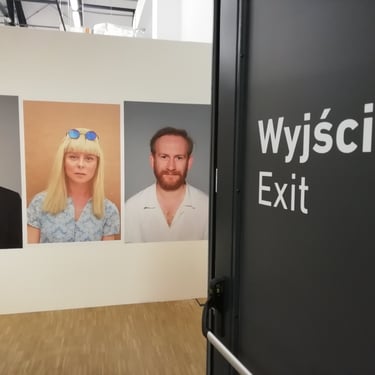
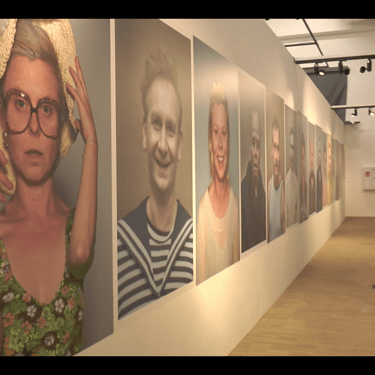
The narrow corridor was lined with eighteen photographs measuring 100 × 150 cm, depicting portraits of eighteen characters inspired by Georg Tabori’s play. All of the characters were portrayed by two actors—Agnieszka and me—and photographed by Zbigniew Libera during a specially arranged photo shoot. The photographs constituted an autonomous artwork reflecting on the construction of image and identity, as well as on age and the process of growing old.
Six fifty-inch plasma screens were mounted on each of the two side walls of the Conference Room. They were arranged in rectangular formations, with three screens placed side by side and another three directly beneath them. The screens showed a film based on the opening scene of Tabori’s text.
Each screen displayed a fragment of the material before freezing on a still image. The next screen then began showing the following part of the film. Through this multiscreen arrangement, viewers experienced the work sequentially but also in a fragmented manner, requiring them to participate actively in reconstructing the linear narrative.
A small loudspeaker was placed in the right-hand corner of the room. It played the film’s soundtrack together with the following recorded voice-over:
“It is 8:30 a.m. on 15 June 2066, and the man in the white raincoat is one Karl Korn, aged fifty-one, who appears to have escaped the inspection carried out every month by Pol-Pol among all people over the age of fifty.”
Our intention was to create an authentic situation that referred directly to the monthly selection of citizens depicted in Georg Tabori’s play, while placing the viewer in the position of an active participant from the very beginning.
The installation was based on the idea of creating a real experience of exclusion through the elimination of people over the age of fifty. In Zbigniew Libera’s installation, this meant that visitors aged 50 and over who wished to enter the main exhibition hall had to make themselves “younger”. In order to pass through the gate, they had to lie deliberately and conceal their age.
Crucially, the decision to do so remained entirely in the hands of each participant. We interpreted this gesture as analogous to the masks worn by Tabori’s characters, who concealed their old age in order to function within an oppressive system.
The looped film shown on the screens, created in the style of film noir, introduced an atmosphere of anxiety and evoked associations with the darkest events of the twentieth century. The voice-over narration from the opening scene intensified the oppressive quality of the fictional world, set in the year 2066.
This carefully designed opening established the foundation for the performative relationship between actor and viewer, as well as between viewer and the space of the installation. In this way, the audience was drawn into a direct, practical and physical experience of the work.
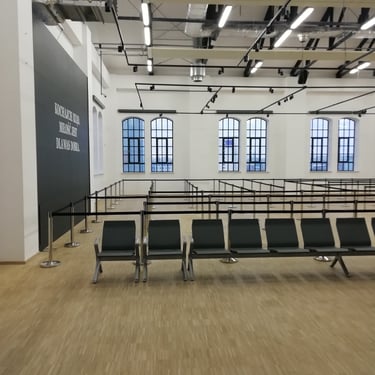
After passing through the “Conference Room”, visitors entered the hall that formed the main part of the installation. This space was intended exclusively for people under the age of fifty. Older visitors were unable to experience the subsequent stages of interaction within Libera’s project or participate in activities involving the actors.
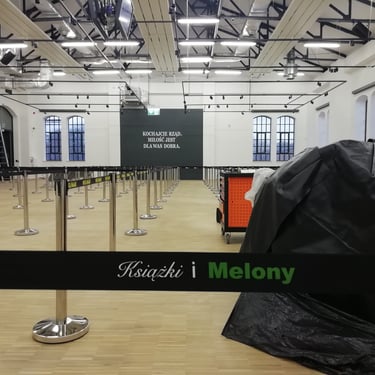
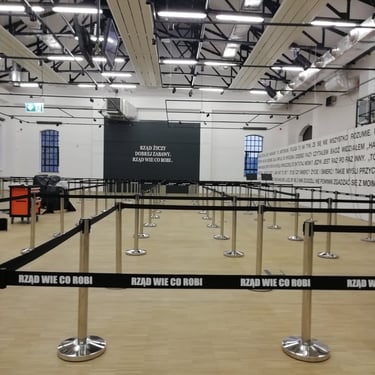
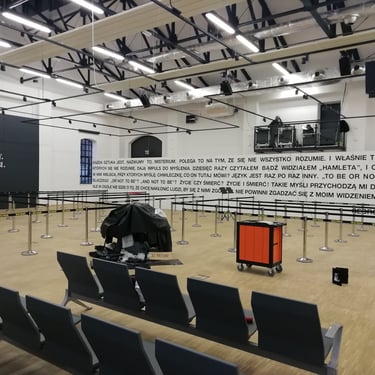
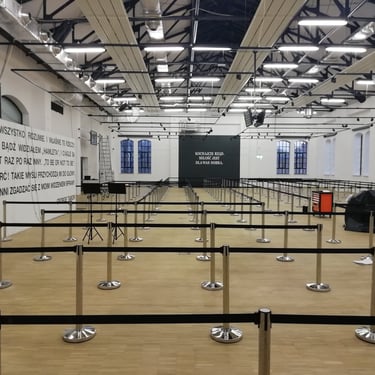
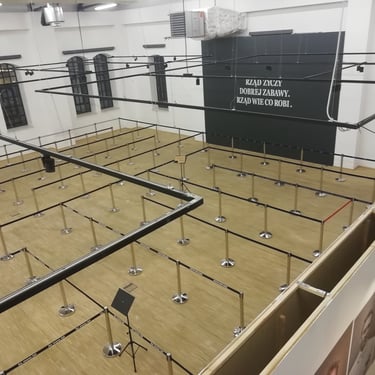
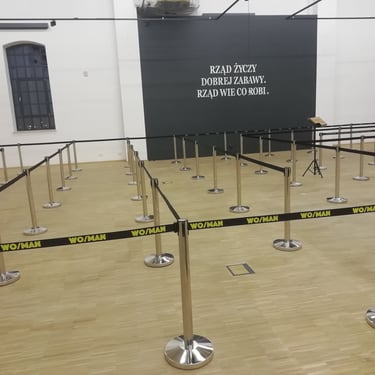
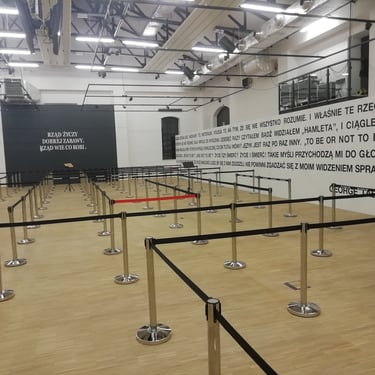
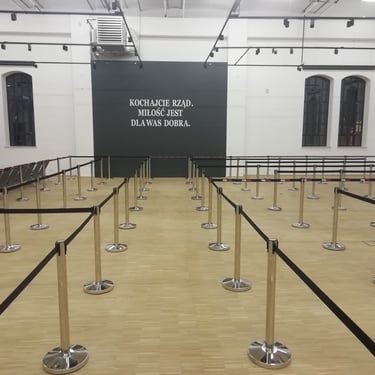
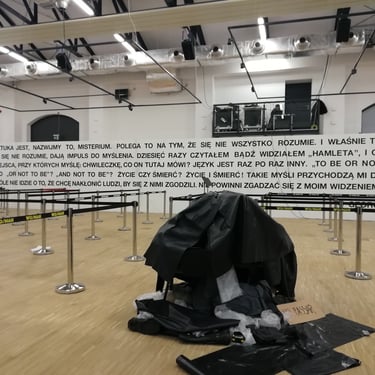
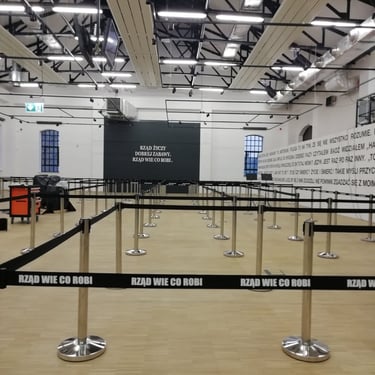
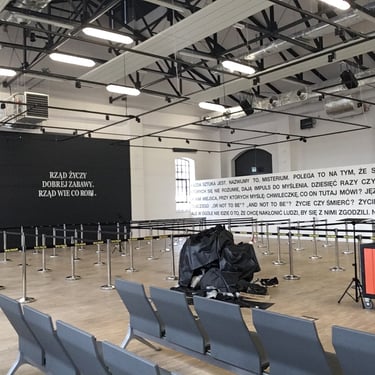
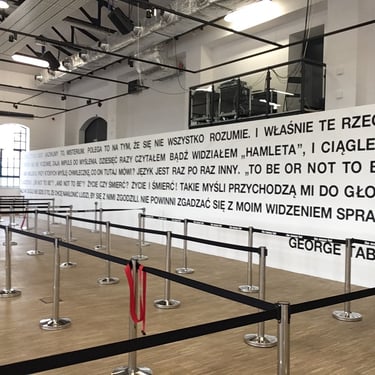
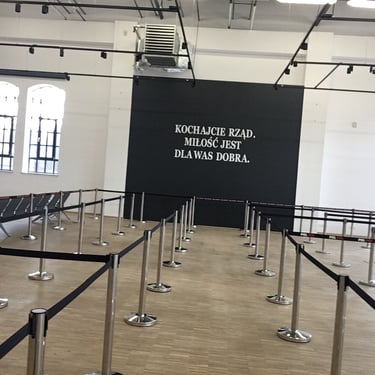
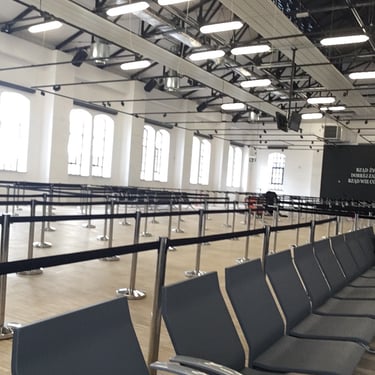
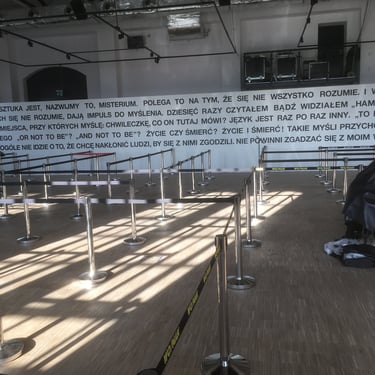
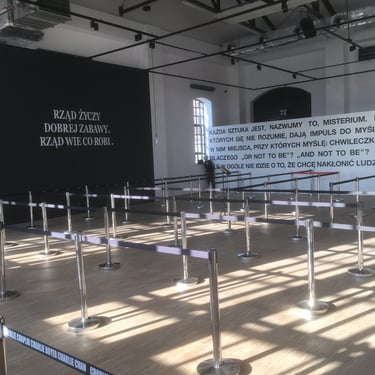
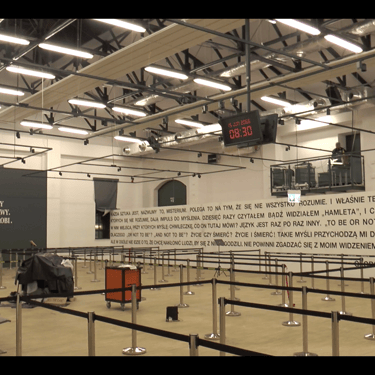
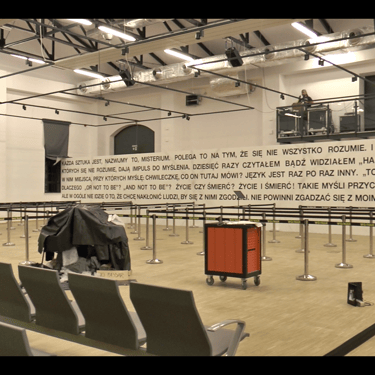
The main installation space was filled with 210 queue barriers connected by black retractable belts. Positioned at intervals of 1.5 metres according to a precisely prepared technical plan, the barriers occupied the entire exhibition hall.
This geometric arrangement formed an extensive labyrinth, leading visitors along winding, rhythmically delineated paths towards an exit located directly beside the entrance doors. To reach the end of the labyrinth, the visitor was therefore required to follow a long, meandering route extending across the entire hall—even though they ultimately arrived almost at the same point from which they had begun.
Within this seemingly orderly yet disorienting space, the softly playing, looped song Sometimes I’m Happy (Sometimes I’m Blue) could be heard from discreetly positioned, concealed loudspeakers. The music created an emotional backdrop, introducing an atmosphere of relaxation, pleasure and nostalgic sentiment. At the same time, it served as a striking counterpoint to the austerity and tension of the first room, creating a subtle, slightly ironic aura that intensified the subversive nature of the entire experience.
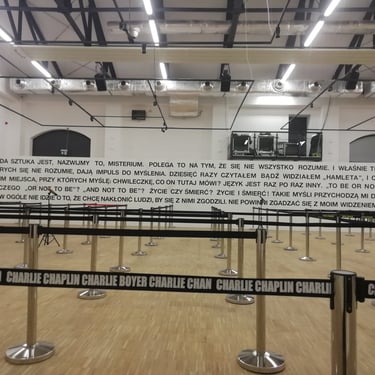
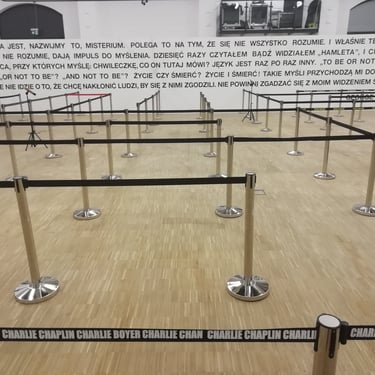
The labyrinth was further divided into twelve zones, identified by inscriptions placed on the black belts: 1.HOW OLD ARE YOU? 2.THE GOVERNMENT WISHES YOU A GOOD TIME. 3.DEATH DOES YOU GOOD. 4.פנים (FACE). 5.BOOKS AND MELONS. 6.CHARLIE CHAPLIN, CHARLIE BOYER, CHARLIE CHAN. 7.WO / MAN. 8.POL-POL. 9.CRYING IS OUT OF FASHION. 10.THE MILE OF LOVE. 11.THE GOVERNMENT KNOWS WHAT IT IS DOING. 12.FINAL STOP WITHOUT LONGING
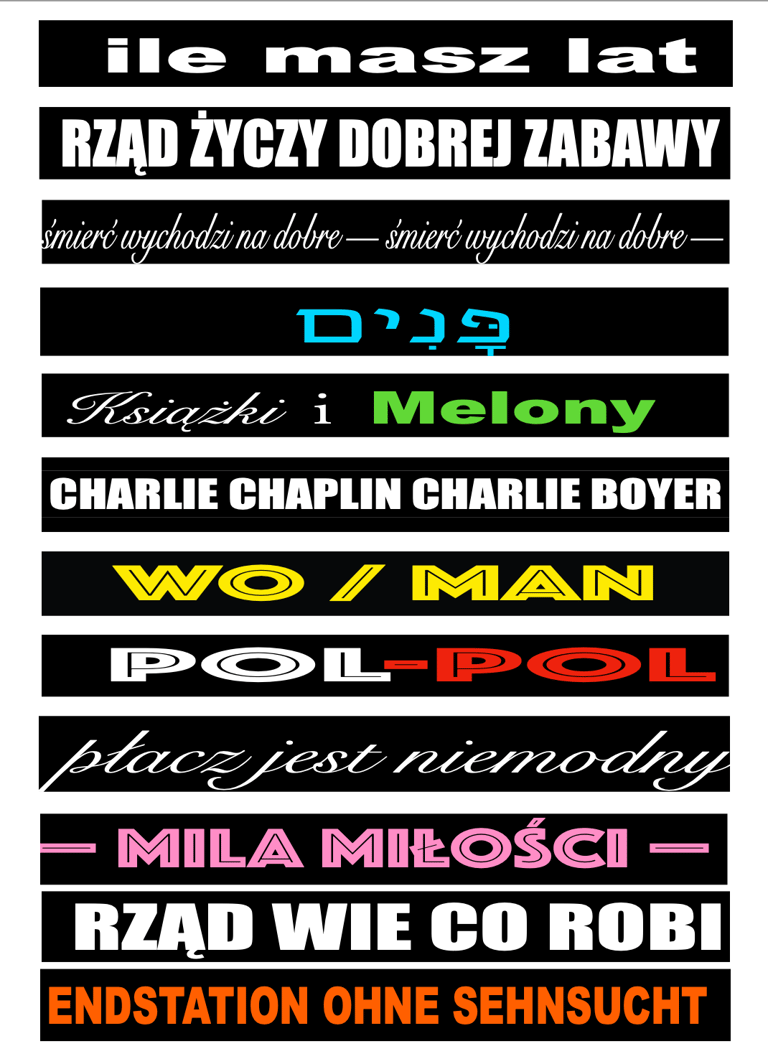
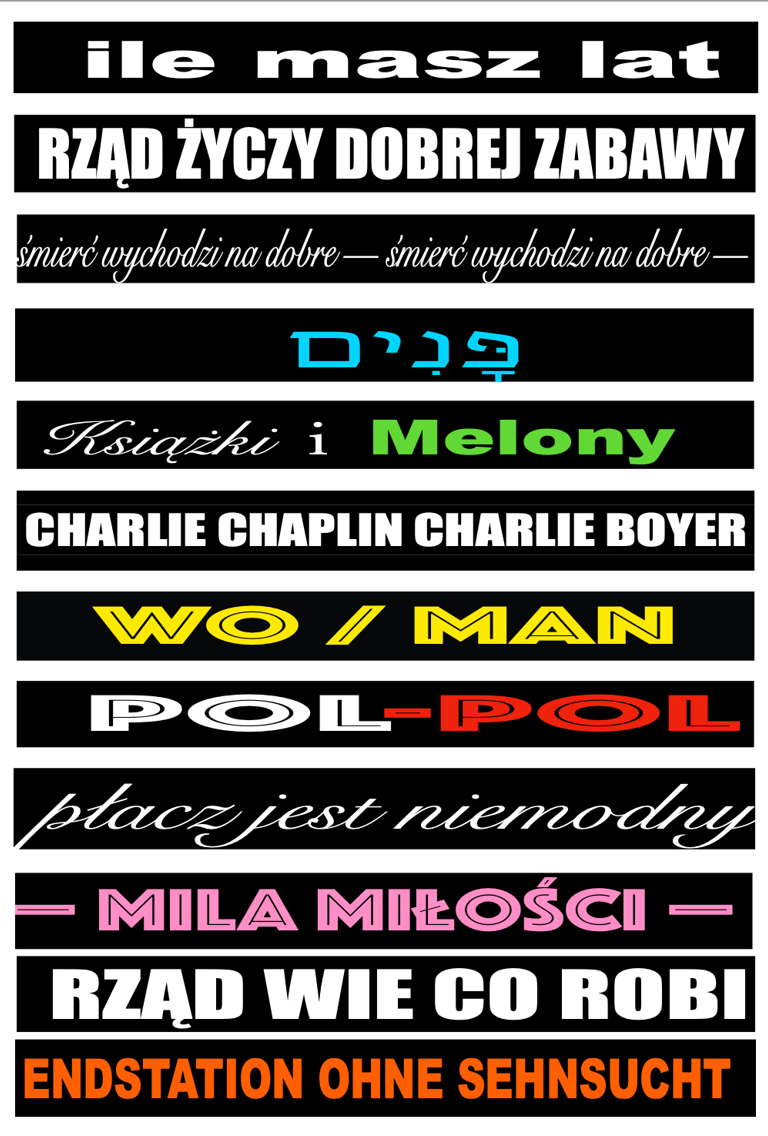
Designs for the inscriptions on the barrier belts by Zbigniew Libera (12 belts).
The inscriptions were taken directly from Premature Departure and presented in a variety of typefaces and colours in order to enhance the sense of the installation’s layered and fragmented character. Printed on the barrier belts, the phrases not only organised the space but also gave it a dramaturgical rhythm. They defined the themes of the individual zones, structuring the narrative sequence of successive scenes and acting interventions.
The first four passages between the zones were additionally blocked by red belts, which stopped visitors at designated points. Whether these barriers were opened or closed depended on the decisions of the two actors acting as guides. By operating the belts manually, they controlled the rhythm and course of the participants’ movement through the installation.
The actors asked each visitor: “How old are you?” They then decided whether the person could proceed to the next zone on the basis of the answer given. Visitors aged fifty or over who had previously concealed their age in order to enter the main space were required either to remain in the zone or to leave the installation. To continue their participation and move further through the labyrinth, they had to maintain the lie about their age.
The purpose of this device was to apply consistently the principle of selection and control introduced earlier in the “Conference Room”. Despite the change in mood created by the music and the more “welcoming” atmosphere, we wanted participants to retain a sense of the oppressive nature of the situation.
The repeatedly asked question about age functioned as a kind of game intended to confront participants with the very real experience of age becoming an arbitrary criterion determining both their right to participate and the way in which they were permitted to function within the structure of the artistic event.
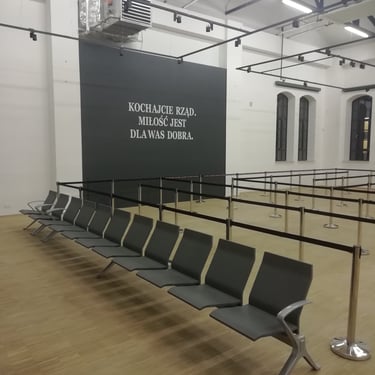
At the centre of the labyrinth was an open area containing three rows of airport seating and an object entitled Igloo, which is described in detail in the following chapter. This space functioned as the “disco”—one of the key locations in Georg Tabori’s text—and formed the climactic element of the installation’s overall dramaturgical composition.
A similar area was planned at the end of the labyrinth. Equipped with identical seating, it allowed visitors to watch the final film, an adaptation of the last section of the play.
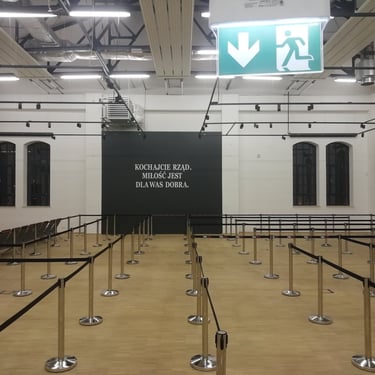
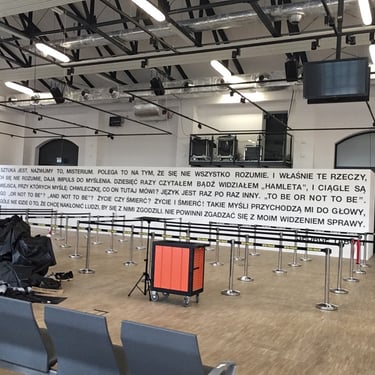
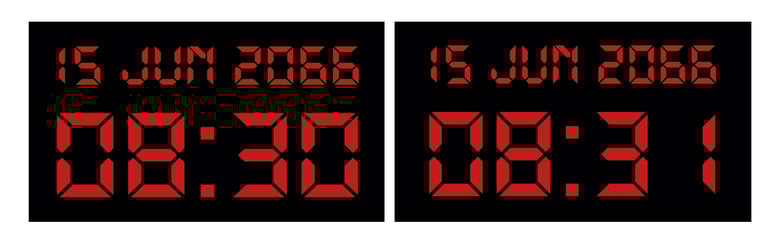
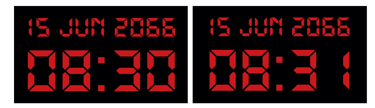
Another important element of the installation consisted of two flat-screen televisions suspended high above the space and positioned parallel to one another. Their screens displayed a clock showing the date and time: 8:30 a.m., 15 June 2066. At intervals, the time changed from 8:30 to 8:31 before returning again, creating a looped, hypnotic rhythm that intensified the impression of being suspended in time and of the inevitability of the events to come.
Next to the clocks was an emergency-exit sign—a green rectangle featuring a white pictogram of a running figure and an arrow pointing vertically downwards. This element was treated not merely as a safety sign, but also as a significant artistic component.
In our interpretation, it became a monument to Gustavus Adolphus, also known as Gustav the Sensitive—a character referred to in Tabori’s play. This seemingly symbolic monument acquired a metaphorical dimension: within its “testicles”, the author located the editorial office of the clandestine newspaper The Secret.
Monumental slogans taken directly from Tabori’s text formed an integral element of the space and completed its visual composition. Their presence on the walls referred to the theme of propaganda depicted in Premature Departure.
Enormous inscriptions were placed on the hall’s two side walls, both of which had been painted black. The slogan on the right-hand wall read:
THE GOVERNMENT WISHES YOU A GOOD TIME. THE GOVERNMENT KNOWS WHAT IT IS DOING.
The inscription on the left-hand wall read:
LOVE THE GOVERNMENT. LOVE IS GOOD FOR YOU.
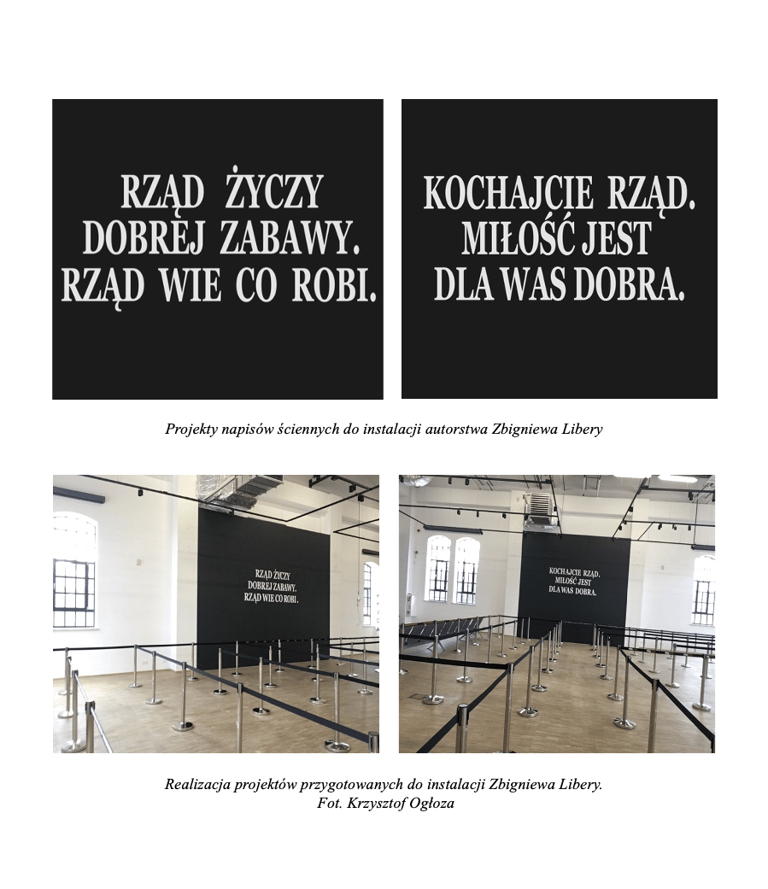
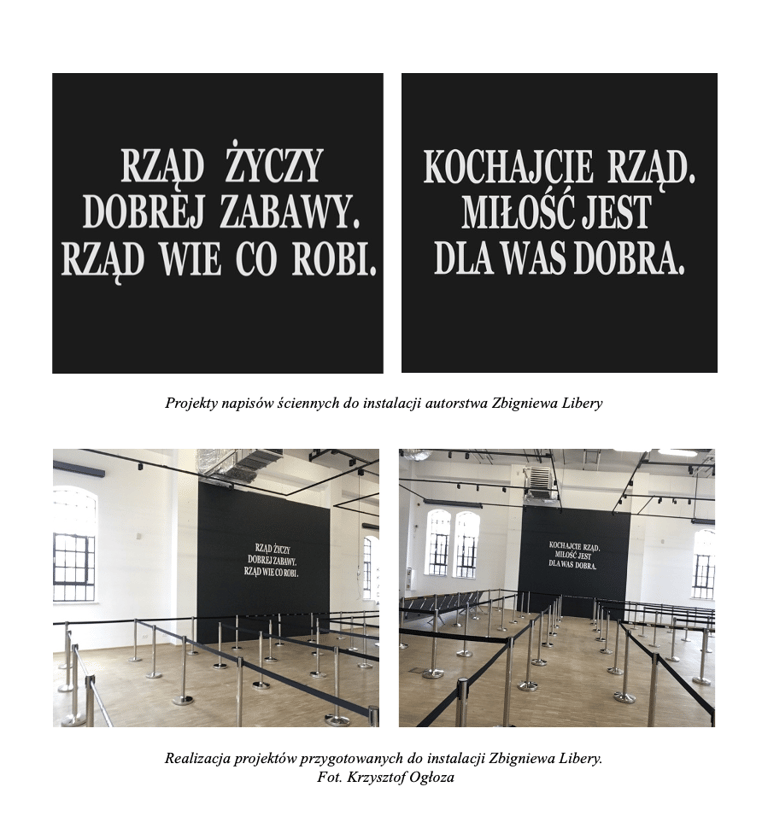
Execution of designs prepared for Zbigniew Libera’s installation. Photo: Krzysztof Ogłoza.
In addition, the following quotation, which opens the text and is accompanied by the author’s name, was placed on the white exterior wall running alongside the corridor described above:
EVERY PLAY IS, LET US CALL IT, A MYSTERY. IT WORKS BECAUSE NOT EVERYTHING IS UNDERSTOOD. AND IT IS PRECISELY THE THINGS WE DO NOT UNDERSTAND THAT PROMPT US TO THINK. I HAVE READ OR SEEN HAMLET TEN TIMES, AND THERE ARE STILL PASSAGES IN IT THAT MAKE ME THINK: WAIT A MOMENT, WHAT IS HE SAYING HERE? LANGUAGE IS DIFFERENT EVERY TIME. “TO BE OR NOT TO BE.” WHY “OR NOT TO BE”? WHY NOT “AND NOT TO BE”? LIFE OR DEATH? LIFE AND DEATH! THESE ARE THE THOUGHTS THAT COME TO MY MIND, BUT MY INTENTION IS NOT TO PERSUADE PEOPLE TO AGREE WITH THEM. THEY SHOULD NOT AGREE WITH MY VIEW OF THE MATTER.
GEORG TABORI
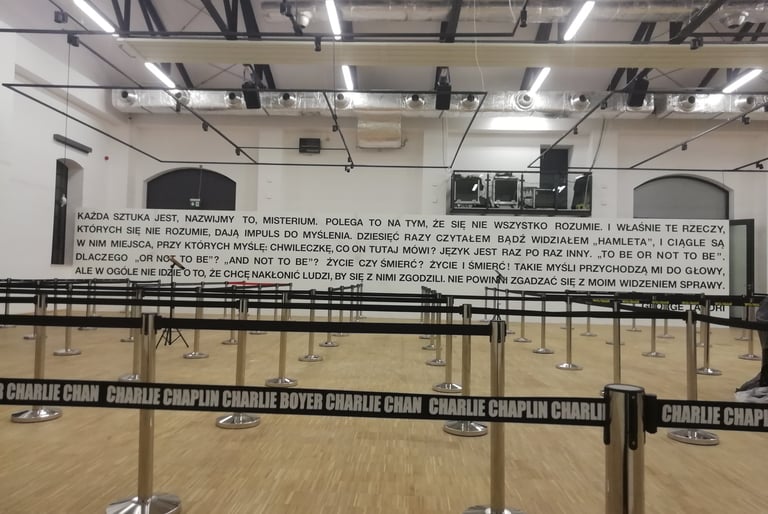
Detail of Zbigniew Libera’s installation. Photo: Zbigniew Libera.
The monumental inscriptions, juxtaposed with the minimalist form of the clock, intensified the impression of omnipresent mechanisms of control. Their scale subconsciously created a sense of being overwhelmed. In this way, the space ceased to function merely as a site of aesthetic experience and became a vehicle for political and ideological meaning.
Every element—the text, the sound, the image—conveyed a specific message, compelling participants to engage in a continuous process of perception and interpretation. The viewer was confronted with an uninterrupted flow of signals that became instruments of influence and manipulation.
As a result, the space acquired a symbolic dimension, exposing the mechanisms through which individuals are dominated and saturating the entire installation with political tension.
Drawing by Z. Libera showing the installation design for the “Conference Room”. Photo: Krzysztof Ogłoza.
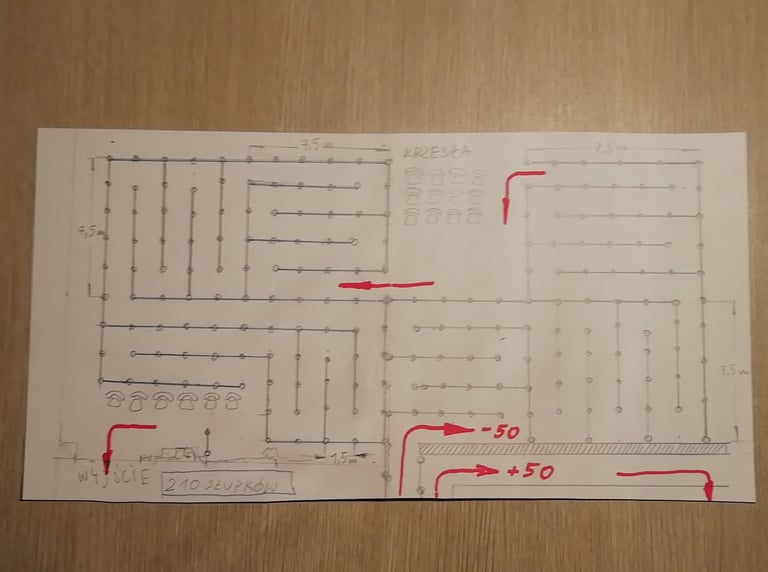
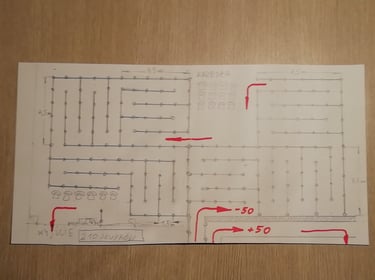
The photograph shows Z. Libera’s drawing of the installation design for the main hall. Photo: Krzysztof Ogłoza.
Design of the clock display matrix for Zbigniew Libera’s installation.



Contacts
Krzysztof Ogłoza
phone; +48 608519443
e-mail: krzysztof.ogloza@gmail.com